Shopify's Fall '26 Edition, titled Exponential, launched on 28 October with more than 150 updates. The theme is Shopify's network effect: every merchant on the platform feeds the signals behind fraud prevention, customer recognition and AI discovery, and every other merchant benefits.
As with every Editions release, "announced" doesn't always mean "available". Some updates are live on every store today. Others are in early access, rolling out gradually, or limited to certain countries or plans. If you have ever gone looking for a feature from an Editions video and not found it in your admin, that's why.
To help merchants find what’s important first, we’ve organised our Shopify Fall ‘26 Editions Roundup by availability.
- Available now. The updates you can start using today.
- Early access and rolling out. Announced, but not yet on every store.
- The bigger direction. Where this release points for the future of eCommerce.
We've also added a UK lens, because a fair share of this release is US-first.
Fall ‘26 at a glance
Statuses are as Shopify listed them at launch on 28 October 2026. Rollouts happen store by store, so check your own admin before planning around any of them.
Available now
These are the updates Shopify has shipped broadly, with no early access or waitlist.
A rebuilt Sidekick
Sidekick now supports merchants by handling more complex tasks. It can run calculations, write code, search the web and remembers what you teach it, so you no longer re-explain your brand or catalog in every conversation.
The bigger change is how it makes edits. You can agree a plan, approve once, and let Sidekick apply several changes together, such as rewriting descriptions across every product in a collection. It can also create and edit draft orders, answer questions about payouts and chargebacks, and help build checkout and customer account customisations.
Its recommendations have moved on too. They now take the apps in your stack into account and draw on web research about your market. Some are tested with SimGym before they reach you, so you can see how a change performed with simulated shoppers before you apply it.
Shopify says daily Sidekick sessions have grown 4.2x year on year.
Our take is the same as with Winter '26: the output is only as good as the data behind it.
Brands with clean product structures and consistent metafields will get far more from multi-step changes than those without, and bulk edits still deserve a human check.
Quality of life changes for Sidekick
A lot of the smaller updates with every Editions release can often be shadowed by the bigger announcements.
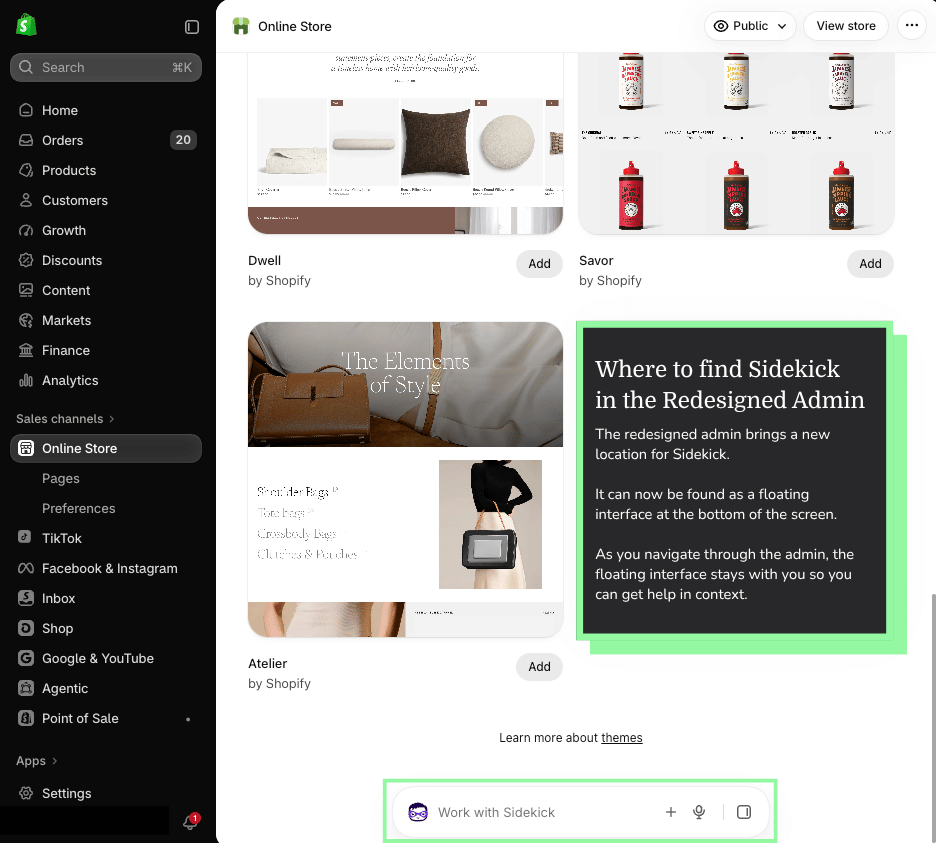
The redesigned admin makes Sidekick available as a floating AI interface on each page.
Kubix tip: If you’re struggling to find Sidekick, it’s now located at the bottom within your Shopify Admin.
Rollouts now coordinate the whole launch
When Rollouts arrived, it brought native A/B testing and scheduled theme changes. Fall '26 widens its scope considerably. A single rollout can now combine your theme, checkout configuration, catalogs and discounts, so a launch or promotion goes live as one coordinated change.
Catalog price changes can roll out across markets and roll back automatically when they end.
Rollouts can also reach headless builds, Shopify POS, Google Shopping and the Shop app. For brands that run frequent campaigns across several markets, this replaces a lot of manual, error-prone switching.
Shopify Protect for fraud and disputes
Shopify Protect brings Shopify's risk and disputes tools together. For stores on Shopify Payments, much of it works without setup:
- High-risk orders are blocked before payment is authorised
- The orders page explains which factors raised an order's risk level
- Carrier proof of delivery is attached automatically to "item not received" disputes
- AI drafts each chargeback response for the specific bank and reason code
Shopify says brands using Protect win 60% more "product not received" disputes. The Rule Builder for writing and backtesting your own fraud rules is still rolling out (more below). If you process through a third-party gateway, most of this won't apply.
Getting found by AI shopping agents
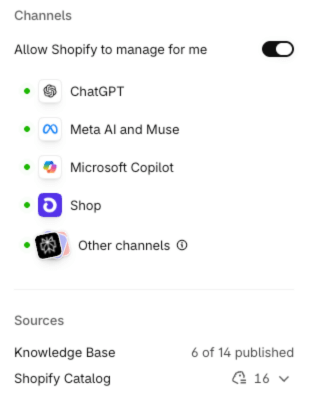
Shopify Catalog is what ChatGPT, Copilot, Meta and other agents use to find Shopify products.
Merchants can view within the admin whether their store is eligible for Catalog, and what to fix if the connection isn’t working.
Alongside it sits a knowledge base (Sales channels > Agentic) where you review and publish the facts agents are given about your store, such as return windows, shipping destinations and FAQs. Shopify drafts them from your storefront, but nothing reaches an agent until you approve it. Compare-at prices also now pass to agents automatically, so markdowns show up in AI chats without extra setup.
This is the most practical step most brands can take on AI discovery today, and it takes very little time.
POS and retail operations
Retail has been growing rapidly over the past few years. Especially when it comes to Shopify POS.
Fall '26 is a strong release for omnichannel brands, with a long list of practical retail updates:
- Saved carts across devices. Any retail assistant can pick up a cart another started, and it survives shift changes.
- Staff management. Manage POS and admin users together, with seasonal staff controls and bulk CSV imports.
- POS activity log. Review refunds, returns, manual discounts and drawer opens by staff name.
- Sales by associate. Track every sale to the staff member who made it.
- Online carts in store. Authorised staff can pull up a known customer's abandoned online cart and close the sale at the counter.
- Native stock counts. Schedule counts by location and timeframe, count in POS by scan or by hand, and review before adjusting inventory.
- Device and connectivity visibility. See every POS device in the admin, revoke a lost one, and check connectivity from the POS home screen.
- Smart grid recommendations. POS suggests new tiles based on what staff search for most, turning repeated lookups into a single tap.
- Native stock counts. Schedule counts by location, scan or count by hand, and confirm discrepancies before inventory updates, with a full audit trail of every adjustment.
None of these need new hardware.
Product data and merchandising
A cluster of catalog updates will matter most to brands with large or complex ranges:
- Product data mapping by channel. Customise how product data maps to each sales channel, kept in sync as the catalog changes.
- Multi-source collections. Combine products, variants and app sources into one collection, and reuse collections across operations.
- Variants on the product page. Edit products and variants together, with bulk variant controls.
- Up to 20 barcodes per variant. With format validation, and scannable in POS.
Analytics, automation and marketing
Analytics gains manual annotations, grouping by category metafields and metaobjects, and app events (such as loyalty points redeemed) alongside store data.
Sessions now use bot filtering and consent-aware counting, which should give a cleaner conversion rate but may shift your baseline against previous periods.
Shopify Flow can now trigger whenever a product's price, tag, metafield or other field changes, and workflows have version history.
Campaign Autopilot is now generally available across Meta, Microsoft Advertising, Snapchat, Shop and Shopify Messaging, with X Ads to follow. It suits merchants without managed paid media best. Brands with established, well-performing campaigns should treat it as something to test against their current setup rather than a replacement.
Worth flagging to your developers
Two platform changes carry deadlines. Apps can no longer create or update script tags and must move to theme app extensions or web pixels. Apps also need to move to expiring access tokens before January 2027 to stay listed.
If you run custom apps or integrations, it is worth confirming both are covered.
Early access and rolling out
These updates have been announced but won't be on every store yet. Some need an early access application, others will appear gradually over the coming weeks and months. They are worth understanding now so you can plan for them, not worth building plans that depend on a specific date.
Canvas: your whole store in one view (early access)
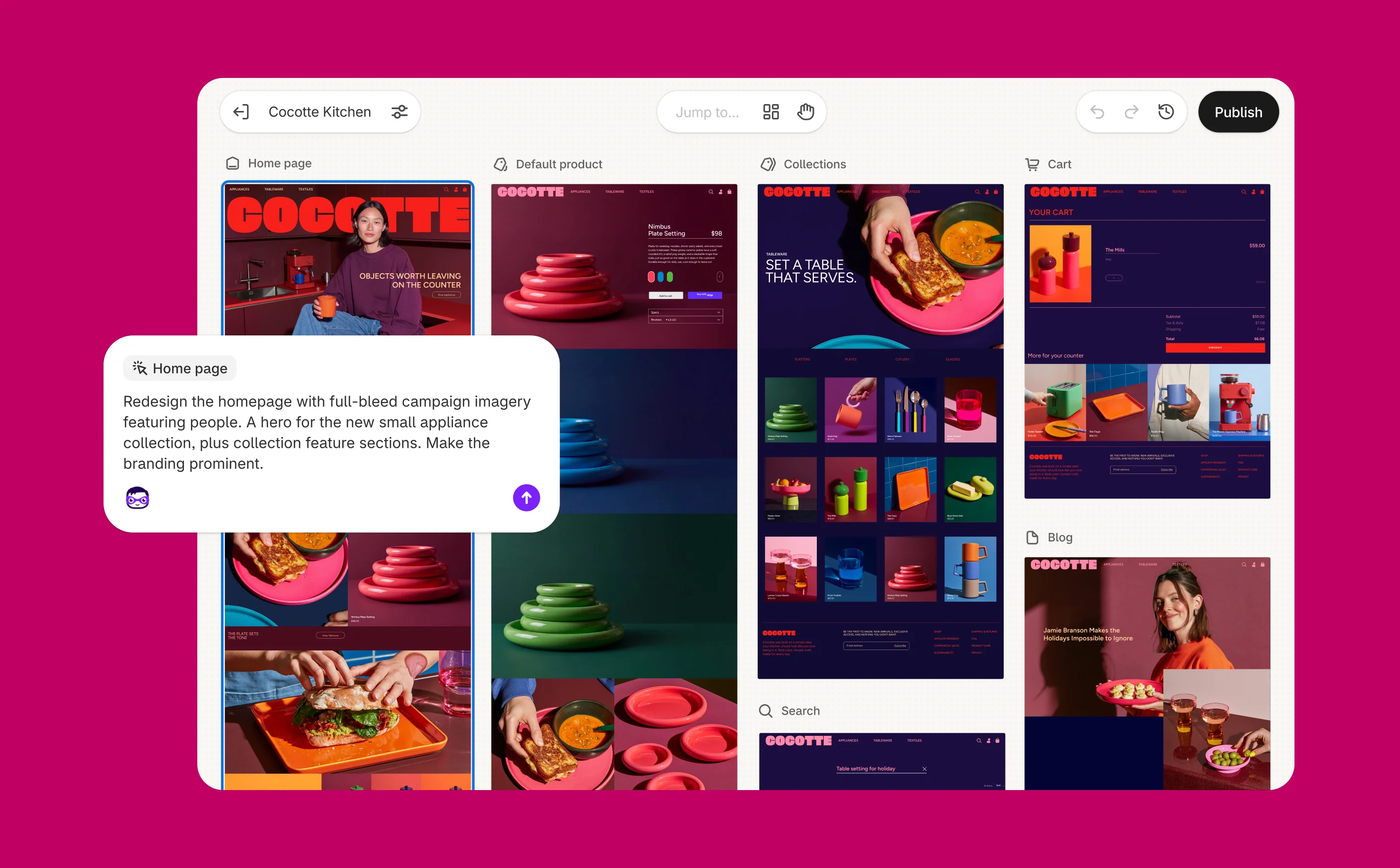
Canvas is the headline of Fall '26. It shows your entire store on one canvas, lets you zoom into any detail, and lets you edit it with Sidekick, from small tweaks to full redesigns built on your theme's design system. Shopify says it takes stores from no theme to launch 20% faster.
It sits on a new theme architecture for developers: Liquid pages composed from blocks with typed contracts, built-in Tailwind styling, and markdown files that teach Sidekick how a theme is built and which design preferences to keep. That last part is really important. It suggests Shopify expects brands and their agencies to define the rules Sidekick works within, rather than leaving it to guess.
For brands with a custom theme, the questions to ask are how well your current theme will work with Canvas and whether a future rebuild should adopt the new architecture. Neither needs answering today, but both are worth raising at your next roadmap review.
A redesigned admin (rolling out)
The admin is getting a full restyle with new colour, type and icons, a collapsible side navigation holding search and notifications, and Sidekick as a floating chat on every page. It is rolling out gradually, with some merchants already having access already.
Checkout updates (rolling out)
Several checkout changes are on the way:
- Custom fields in the checkout and accounts editor, including text inputs, date pickers, checkboxes and choice lists, for things like delivery instructions and gift messages
- A tiled layout for payment methods, replacing radio buttons with a more compact design
- A stacked form layout that reduces scrolling and makes field errors easier to spot
- Apple Pay in any browser, by scanning a QR code with an iPhone
Custom fields are the one to watch. Many brands use apps for exactly this today, and native fields could simplify the checkout stack. We have written before about what a delivery date picker can do for conversion.
More from Shopify Protect (rolling out and coming soon)
The Shopify Protect Rule Builder, where you write fraud rules on the risk signals you choose and backtest them against past orders, is rolling out soon. Chargeback protection is also due to extend beyond Shop Pay orders, with reimbursement on fraud chargebacks.
International selling (early access and coming soon)
Fees on products and collections set per market, collected at checkout with reporting built in, are in early access. A cart preview by market, showing how products, pricing and checkout settings appear to customers in a specific market, is coming soon. Both will be welcome for brands managing several markets from one store.
Shop branding sync (early access)
Your online store's branding and merchandising can sync automatically to your landing page in the Shop app, so there is no need to rebuild it there.
The bigger direction
Some of the most talked-about Fall '26 updates aren't features you switch on. Shopper-side changes are reducing friction for consumers, enabling more opportunities to shop across different channels.
It also gives a good vision of how Shopify and consumer shopping habits are evolving.
Shopping inside AI agents
Fall '26 goes further on agentic commerce than any release before it:
- Shop.md. A shopping skill shoppers can give to ChatGPT, Claude or another agent, letting it search over a billion products, check out with Shop Pay and track orders.
- Shop Pay in personal agents. Checkout inside Muse from Meta, Claude Duet and Instinct, with the buyer approving each purchase and their card never shared with the agent.
- Selling in Google. Checkout powered by Shopify in Google Search, including AI Mode, and in the Gemini app, with orders managed in the admin.
- Retail locations for agents. Agents can find your physical stores and direct shoppers to the nearest one.
- ChatGPT Ads. A new app for sponsored placements in ChatGPT, tracked in the admin.
The common thread is that your product data and published store facts are becoming your storefront in places you don't design. That's why the Catalog eligibility and knowledge base updates above are worth doing now, and why clean metafields and attributes keep coming up in every Editions release.
Recognising more customers in store
Shopify POS can now recognise more in-store shoppers through the network of people who have checked out with Shopify Payments at any store. When a shopper chooses a digital receipt and agrees to share their details, POS saves them to a customer profile. Shopify says a known in-store customer has over 60% higher lifetime value than an unknown one.
For unified commerce brands, this closes one of the most stubborn gaps in retail data: knowing who bought in store. Expect it to feed retention and clienteling strategies over the next year.
Shop as a channel in its own right
Shop now has a home on the web at shop.com, a universal checkout for carts spanning several brands, and two-way cart syncing with your online store. Shop Campaigns, which only charges when an ad drives a sale, has expanded to more than 35 new markets including the UK.
Taken together, these updates are the Exponential theme in practice: more of your sales can start in places Shopify's network reaches, not just on your own site.
What it means for UK brands
Like with all Editions releases, a lot of early coverage of Fall '26 is US-led. These updates are limited to other regions or specific businesses for now:
The updates that we see as really valuable for UK merchants:
- Royal Mail pickup points and DHL Express labels in the admin
- Printed POS receipt templates that add UK tax summaries automatically
- Shop Campaigns now available in the UK
- Seven new local payment methods. Most target other markets (Satispay, MB WAY, OXXO, GrabPay), but Alipay and WeChat Pay at the till could suit UK stores with a lot of international visitors. Check availability on your Shopify Payments account first.
Making Fall '26 work for your store
Exponential is one of Shopify's broadest releases, and the network effect behind it is real. But the value for any one brand comes from knowing which updates are live, which are worth waiting for, and which simply don't apply yet.
If you'd like help working out which Fall '26 updates are worth acting on for your store, or how features like Canvas and the rebuilt Sidekick fit your roadmap, our team is happy to talk it through.