



eCommerce in 2026 offers an opportunity for bands that think about their business in systems, not silos. Data, automation and experience are no longer separate conversations. They are the same one.
From our perspective as a Shopify agency working across growth strategy, CRO, retail and B2B, the direction is clear. Smarter data enables smarter automation, and both are essential to building customer journeys that convert, retain and scale.
Here are the eCommerce trends in 2026 that will matter most and what merchants should be doing now to stay ahead.
Our six eCommerce predictions for 2025:
- Agentic Commerce is here and will evolve throughout 2026
- AI will bring smarter automations
- Data is King with first-party data being a crucial growth factor
- Live Shopping & Shoppable video takes centre stage
- Retail is back with eCommerce brands leading the change
- B2B and new growth channels for many Shopify merchants
.avif)
1. The Headline Shift for 2026
Agentic commerce is coming FAST
One of the biggest takeaways from Shopify Winter Editions 2026 is Shopify’s focus on agentic commerce.
Agentic commerce refers to systems that do more than execute predefined rules. Instead of waiting for instructions, they interpret intent, make decisions, and take action across multiple steps. In simple terms, software starts behaving less like a tool and more like a colleague.
This is already taking shape across Shopify, where AI is being embedded deeper into core workflows. Not just answering questions or generating copy, but actively supporting merchants with tasks like analysing performance, identifying opportunities, and automating decisions across operations, marketing and customer experience.
The important point is this. Agentic commerce is not about replacing teams. It is about removing friction and decision fatigue so people can focus on strategy, creativity and growth.
Why this matters for merchants.
As stores scale, complexity increases. More channels. More products. More customers. More data. Traditional automation struggles here because it relies on rigid rules that break the moment behaviour changes.
Agentic systems adapt. They learn from patterns across data sets and respond in real time.
We’ll delve a little deeper into agentic commerce in the next section. Spending a lot of time exploring Shopify’s new functionalities with its Winter Editions Release, we put together the best new Shopify features for 2026.
AI & Smarter automations
For years, automation in eCommerce has been largely rules-based. If a customer does X, trigger Y. While this still has value, it struggles to keep up as businesses scale and operations become more complex. AI changes this by adding context and intelligence to operational decision-making, not just speed.
AI is moving beyond surface-level use cases and being embedded deeper into how businesses run day to day on Shopify. The focus is less on flashy features and more on reducing friction across core operations.
Where AI actually delivers value for eCommerce businesses.
The biggest gains from AI in 2026 are not coming from novelty. They are coming from removing bottlenecks in areas that consume time, introduce risk, or slow growth.
Common examples include:
- Operational triage, helping teams prioritise what needs attention now rather than reacting to everything
- Inventory and fulfilment signals, highlighting issues before they impact customers
- Customer support routing, reducing manual handling while improving response quality
- Order and payment exceptions, catching problems earlier and reducing downstream admin
The goal is not full automation at all costs. It is smarter assistance that helps teams make better decisions, faster.
Smarter automation, not more
One of the mistakes brands make is assuming AI means automating everything. In reality, the most effective setups in 2026 are selective and intentional.
Smarter automation focuses on:
- High-volume, low-value tasks that slow teams down
- Repeatable decisions where context matters
- Processes that benefit from learning over time
This is where AI-supported workflows outperform traditional rule sets. They adapt as customer behaviour changes, rather than breaking when assumptions no longer hold true.
Operations are becoming part of the customer experience
Operational decisions increasingly shape how customers perceive a brand. Stock accuracy, delivery promises, returns handling, and communication all feed directly into trust and loyalty.
AI helps connect these operational dots. Not by replacing people, but by giving teams clearer insight into what is happening across the business and where intervention will have the biggest impact.
This is especially important as brands expand across channels, introduce retail locations, or move into B2B. The operational load grows quickly, and manual oversight does not scale.
The limitation most businesses will hit
AI and smarter operations only work as well as the data and processes behind them.
Without clean product data, reliable customer data, and clearly defined workflows, AI simply accelerates poor decisions. This is why many brands struggle to see returns when they adopt AI too early or without a plan.
Which leads to the next major trend shaping eCommerce in 2026.
Where automation actually pays off (real merchant use-cases)

2. Data is king (and first-party is the crown)
Data unlocks flexibility in eCommerce in a way no single channel, strategy or tool ever could. We think this is a huge shift and we’ll see more businesses looking to retain even more data from customers.
When you have control over your data, you understand not just what is happening in the business, but why it is happening. You can see how product data feeds merchandising, how customer data shapes marketing, and how operational data influences experience and profitability.
Most importantly, you can trust the decisions you are making because you understand the logic behind them.
First-party Data Becomes Non-Negotiable
In 2026, owning your customer data is no longer optional. Privacy changes, platform shifts and rising acquisition costs have made reliance on third-party signals increasingly fragile.
First-party data gives brands control. It allows you to understand behaviour across touchpoints, build meaningful segments, and activate campaigns without rebuilding processes every time something changes.
Within platforms like Shopify, this ownership becomes a strategic advantage. When your customer, product and order data is structured properly, everything else becomes easier to execute.
From Dashboards to Decisioning
Many businesses collect data but never truly use it. Dashboards tell you what happened. Strong data foundations help you decide what to do next.
When data is clean and connected, teams can move faster and with more confidence.
Decisions about pricing, promotions, inventory and messaging stop being guesswork and start becoming informed actions.
This is where smarter data directly supports smarter automation and stronger customer journeys.
Better data leads to better marketing efficiency
The real return on investing in data comes through efficiency.
When customer data is segmented properly, brands can deliver the right message to the right person at the right time. That can lead to higher engagement, stronger conversion rates, and lower cost per acquisition.
It also opens the door to more creative marketing strategies without increasing operational complexity.
For example, if you are sitting on excess stock at the end of a season, data allows you to target customers based on how they actually shop. Segmenting by size, purchase history or product preference makes it possible to build targeted offers like mystery bundles that feel relevant, not desperate.
The result is faster stock clearance, better margins, and a stronger customer experience.
Data as the foundation for everything else
As eCommerce becomes increasingly automated, more omnichannel and more customer-centric, data is the common thread that holds it all together.
Without strong data foundations, AI struggles, automations misfire, and customer journeys feel disconnected. With them, brands gain the flexibility to adapt, experiment and grow without constantly rebuilding their tech stack.
In 2026, data is not just something you measure. It is the engine that powers every meaningful decision you make.
.avif)
3. Live shopping and shoppable video (entertainment meets conversion)
Live shopping and shoppable video are no longer experiments sitting at the edge of the funnel. In 2026, they are becoming embedded parts of how customers discover, evaluate and buy products.
What has changed is not just the format, but how these experiences connect into the wider customer journey. Consumers are able to get a deeper level of connection with a brand and feel a part of a community.
Live Shopping is maturing
Early live shopping was often treated as a novelty. Flashy streams, broad discounts, and limited follow-up. In 2026, the brands seeing consistent results are now taking a more considered approach.
Whilst the promotional aspect of Live Commerce is important, businesses still need to stand out and deliver some sort of value and connection with their audience.
Rather than chasing raw viewer numbers, merchants should start to focus on engagement quality, repeat attendance and downstream conversion. As live shopping is becomes a moment within a longer relationship, not a standalone event.
A really big underlying theme that we see from consumers is the desire for real experiences, whether that’s live on TikTok whilst they’re cooking dinner or attending your pop-up shop.
This is where the bigger picture of data starts to feed into your business, as you can push activations across different channels whilst still staying relevant.
Consumers want to watch content. If the brands that they love produce content, they’re more likely to watch it.
In-video shopping becomes “in-journey shopping” for eCommerce Brands
Shoppable video is evolving beyond simple product tagging, which will only get more advanced as we move throughout 2026.
Customers increasingly expect to move seamlessly from inspiration to action without breaking context. Watch a clip, explore a product, check delivery options, and purchase, all without leaving the experience.
Over the next couple of years, we will see video shopping expanding beyond just a tag under a video. A native shopping experience whilst watching your favourite YouTube channel or catching up on the latest Netflix binge is how video commerce is developing.
In video checkout experiences when products are featured in a show is likely to start taking place.

4. Retail is back (and unified commerce is the advantage)
The best brands stop thinking “stores vs online”. Every channel, strategy and brand experience should feed into one another. Again, this is made much easier when you have agile data as the foundation.
POS becomes a growth channel, not a till
Shopify POS unlocks a key role within your business which changes your brand experience completely. It sits at the centre of how you understand your customer and are able to collect data, creating a more cohesive shopping experience.
As consumers seek more in-person experiences, we will start to see more brands activate experiential events, pop-up stores and acquiring retail locations.
Retail will start to take a shift from shopping to a more consultative approach for many businesses. Shop floor representatives can start to offer personalised experiences whilst being able to collect first party data that can then feed into other marketing activities.
Operations are the experience
The backbone of omnichannel eCommerce and offering the best experience is the business operations.
Stock accuracy, fulfilment speed, returns handling and communication all directly influence how a brand is perceived. When systems are disconnected, friction appears quickly. When operations are unified, experiences feel seamless.
As brands introduce click and collect, ship from store, endless aisle and hybrid fulfilment models, operational clarity becomes essential. Retail success in 2026 will depend less on where a sale happens and more on how well every part of the operation works together.
Unified commerce turns retail from a cost centre into a growth engine.

5. Omnichannel eCommerce (the journey becomes the product)
Customer journeys are “warped” because people move with zero friction. Jumping from channel to channel, seeing multiple different campaigns and socials, it’s hard to pinpoint a single point of attribution for a conversion.
This is the reality of omnichannel commerce in 2026. The journey itself becomes the product.
As competition increases across paid channels, the cost of acquiring attention continues to rise. More brands are bidding on the same audiences, using similar creative formats, and operating on the same platforms. The result is predictable. Higher CPMs, rising CPAs, and diminishing returns for brands relying solely on paid acquisition.
This is why tracking and data collection become critical.
The brands that perform best are not simply spending more. They are learning more. Every interaction becomes an opportunity to understand intent, preference and behaviour, then use that insight to improve relevance at the next touchpoint.
Better tracking leads to cheaper marketing
When tracking is set up correctly, omnichannel marketing becomes more efficient, not more complex.
Rather than treating every customer as new, brands can segment audiences based on how they actually behave. What they browse. What they buy. How often they return. Where they drop off and which resonate best.
This level of segmentation allows brands to:
- Deliver more relevant messaging across channels
- Reduce wasted spend on low-intent audiences
- Increase conversion rates without increasing budget
- Shift focus from acquisition to retention and lifetime value
The result is marketing that feels more personal and costs less to run because it relies on insight rather than brute force.
Marketing attribution is evolving, not disappearing
In the new omnichannel world, traditional attribution models break down quickly. Last-click rarely tells the full story, and even multi-touch models struggle to capture offline interactions, creator influence and brand-led discovery.
Rather than chasing the perfect attribution model, leading brands are focusing on contribution.
Understanding which channels influence behaviour, how journeys overlap, and where messaging supports decision-making is far more valuable than trying to assign all credit to a single click.
Platforms like Shopify play an important role here by helping connect data across channels, retail and customer touchpoints, giving brands a clearer picture of how journeys actually unfold.

6. B2B and new growth channels (B2B2C, marketplaces, and collaborations)
B2B is not new, but the way it is delivered is changing fast. Today’s eCommerce platforms allow brands to run B2B and DTC side by side, without the operational drag that traditionally made wholesale slow, rigid and admin-heavy.
B2B channels can deliver high-value, repeat revenue with far lower acquisition costs than consumer eCommerce. In quieter trading periods, those larger, planned orders often provide the stability that DTC alone cannot. The difference in 2026 is that more of this activity is happening directly within Shopify, without relying on disconnected systems or manual processes.
We have delivered B2B and hybrid trade setups for brands where wholesale needs to work just as hard as their direct-to-consumer channel, often within a single storefront. That means designing for trade pricing, customer-specific access, complex inventory rules and operational integrations, all without fragmenting the buying experience.
Through Shopify B2B setups and partnerships with tools like SparkLayer, we align Shopify’s native B2B capabilities with ERP, fulfilment and finance systems. The result is a joined-up setup that gives trade customers speed and clarity, while giving internal teams control and confidence as the business scales.
This is not about bolting wholesale features onto a store. It is about architecting a connected commerce operation where B2B feels as considered, efficient and commercially sound as DTC, built for long-term growth rather than short-term fixes.
B2B eCommerce is getting more customer-centric
Marketplace-style selling is no longer owned by giants alone. Consumers are already trained by platforms like Amazon to expect wider choice, fewer checkouts, and a single point of accountability. What’s changing is where that behaviour now shows up.
We’re seeing established brands adopt a more curated version of the marketplace model. Large fashion and lifestyle retailers have shifted towards hosting complementary brands within their own ecosystem. Not everything, everywhere, all at once. Instead, carefully selected products that extend the customer journey without diluting brand identity.
This is where Shopify Collective becomes interesting for 2026. Shopify Collective is available in the UK and US and has other requirements for merchants to become listed.
Launched in 2023, Shopify Collective allows merchants to feature and sell other brands’ products directly within their own Shopify store. This isn’t about turning every Shopify store into the next Amazon. It’s about collaboration over competition.
For consumers, the value is obvious. A broader, more relevant range of products in one place. One basket. One checkout. One point of contact. That peace of mind removes friction and, in many cases, increases conversion rates. Shoppers feel like they’ve achieved more while spending less time moving between sites.
For merchants, Shopify Collective introduces a new channel that sits somewhere between DTC, B2B, and B2B2C. Brands can partner with businesses that complement their own offer, think apparel paired with accessories, equipment paired with consumables, or lifestyle brands expanding their ecosystem without holding additional stock risk.
As attention becomes harder to win and acquisition costs continue to rise, collaborative commerce gives brands another way to grow their share of basket, not just traffic. In 2026, we expect more merchants to treat Shopify Collective not as an experiment, but as a deliberate part of their growth strategy.
The quiet Shopify updates that make eCommerce smarter
Beyond the headline announcements, Shopify RenAIssance Winter Editions introduced a layer of quieter improvements that signal where eCommerce is really heading. Not flashier storefronts, but smarter operations.
A number of these updates focus on how much merchants understand and act on their data. Not just at high level eCommerce but at all levels. Shopify Rollouts will allow more brands to get creative with campaigns by enabling them to make scheduled storefront changes and to drop back to the normal storefront when the sale ends.
With most sales usually going live at midnight, it makes it easier for merchants to seamlessly kick off their sale without having to wait up.
Rollouts also enables merchants to natively A/B test within Shopify, allowing merchants to test changes within their themes directly, giving them the data they need to make informed changes to their website.
We’re also seeing Shopify lean further into operational intelligence. Automation that reflects real business workflows. Admin experiences that adapt based on behaviour. Systems that anticipate what a merchant might need next, rather than waiting to be told. These aren’t features that shout, but they compound quickly as businesses scale.
What matters here is direction. Shopify is clearly investing in technology that helps merchants move faster with fewer resources. Less manual intervention. Fewer reactive decisions. More confidence that the platform is supporting growth rather than adding complexity.
Throughout 2026 we’re going to see eCommerce get much smarter than it already is, especially when it comes to Shopify.
The clear thread that runs through all of our predictions is that data and operations are at the heart of everything that you do and plan to do in the future. The data that you collect should speak to all of your systems to result in cohesive business operations.
Shopify Gross Merchandise Volume (GMV)
Shopify’s GMV trajectory tells a simple story: innovation compounds. As the platform continues to remove friction across checkout, fulfilment, retail, B2B and international selling, more commerce flows through it, and it keeps accelerating.
By Q3 2025, Shopify processed $92.01 billion in GMV in a single quarter, a milestone that reflects more than just merchant growth. It shows how deeply Shopify is embedded into how modern commerce actually operates. Online, in-store, cross-border and wholesale are no longer separate motions. They are part of one connected system, and Shopify keeps strengthening that system quarter after quarter.
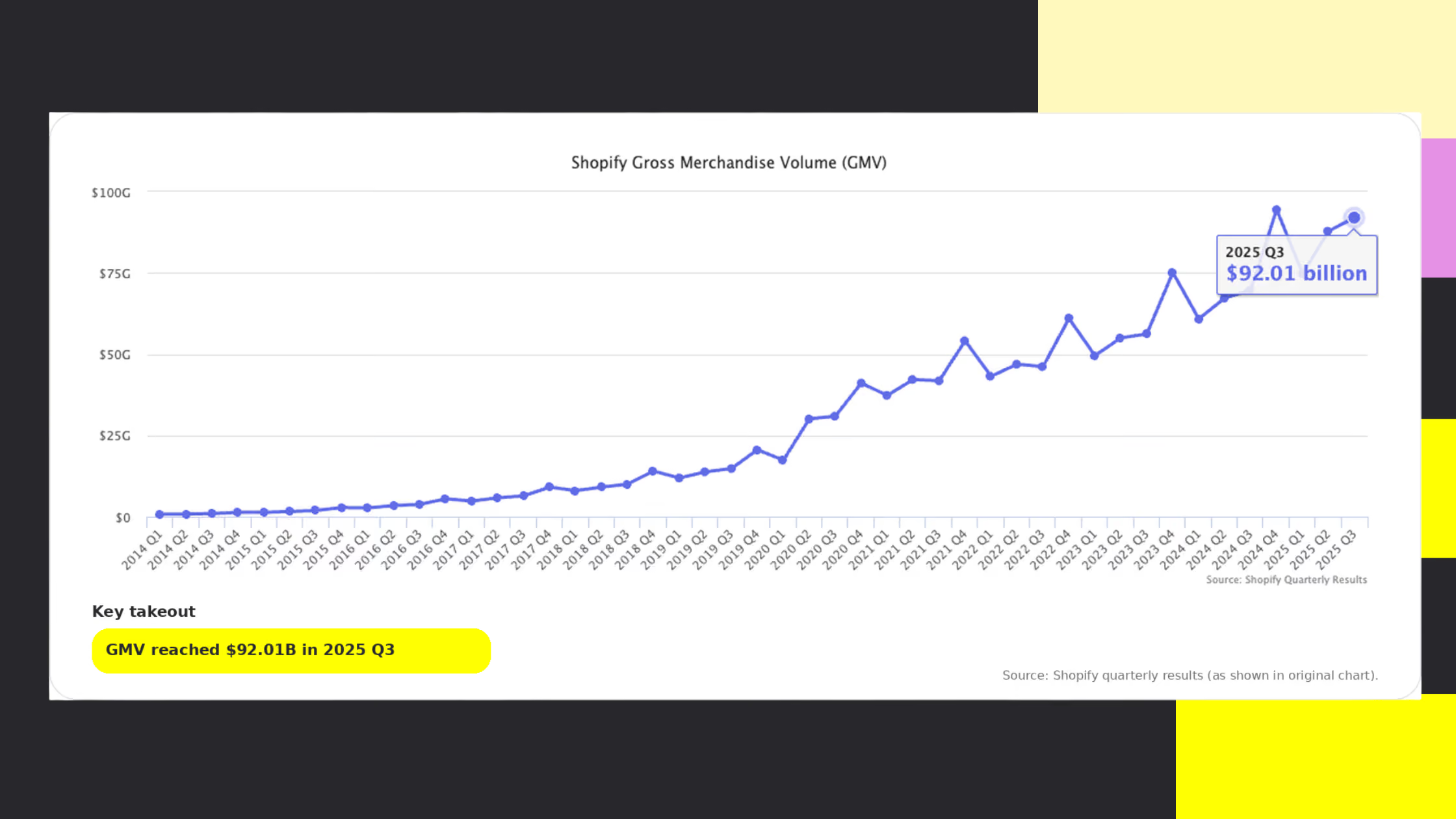
For brands, this matters. Platform innovation at this scale de-risks growth. It means faster adoption of new channels, better performance during peak, and tooling that evolves without businesses having to rebuild their foundations every few years. Shopify’s GMV growth isn’t a vanity metric. It’s evidence that merchants are voting with volume, and they’re doing it consistently.
FAQs 2026 eCommerce trends
What is agentic commerce, and should retailers adopt it now?
Agentic commerce is the next evolution of eCommerce, where AI agents actively support and act on behalf of customers. Instead of shoppers manually searching, comparing and checking out, intelligent agents can anticipate intent, evaluate options, personalise recommendations, and complete transactions across multiple steps. Always guided by human goals, but capable of acting independently at speed.
For retailers, the opportunity is immediate. Agentic commerce reduces friction, shortens decision cycles, and creates more relevant, high-intent customer journeys. Brands that adopt it now gain a clear advantage. They learn faster, build stronger data foundations, and shape how customers interact with their store before competitors do. Waiting means playing catch-up in a world where buying decisions are increasingly automated.
The retailers that win will be those who treat agentic commerce not as a future concept, but as a capability to build into their stack today. Start small, integrate responsibly, and use it to enhance real customer value. Built properly, it strengthens trust, improves conversion, and sets your business up for the next phase of eCommerce growth.
How do you make AI automation work in eCommerce?
Clean product data, accurate customer segmentation, and reliable tracking are what allow AI tools to make meaningful decisions. Without this, automation simply accelerates the wrong outcomes. When the basics are in place, AI can drive smarter personalisation, better stock forecasting, faster customer support, and more efficient marketing execution.
The key is incremental adoption. Start with focused use cases such as lifecycle email automation, demand prediction, or customer service triage. Measure impact, refine the logic, then scale.
When implemented, AI automation becomes a growth engine. It frees teams to focus on strategy and creativity, improves customer experiences at scale, and helps businesses grow stronger without adding unnecessary operational weight. Built right, it makes eCommerce work better for everyone involved.
How do you build a stronger omnichannel customer journey?
A stronger omnichannel customer journey starts by treating every touchpoint as part of one connected experience, not separate channels competing for attention. Customers move fluidly between online stores, social, email, paid media, marketplaces, and physical retail. Your job is to make that movement feel natural, consistent, and useful at every step.
The foundation is unified data. When customer profiles, order history, inventory, and engagement signals live in one place, you can deliver relevant experiences wherever the customer shows up. This is where platforms like Shopify, POS, CRM, and marketing tools must work together, sharing data in real time rather than operating in silos.
From there, consistency matters more than volume. Messaging, pricing, promotions, and service should align across channels, while still adapting to context. A customer browsing on mobile should be recognised in-store. A retail purchase should inform online personalisation. Omnichannel works best when each interaction builds on the last.
The strongest journeys are designed, not stitched together. Retailers that invest in tracking, attribution, and connected systems create smoother experiences, higher lifetime value, and more efficient marketing. When every channel feeds into one journey, the journey itself becomes a competitive advantage.


.png)